Daniel Mark Epstein a review
And a Few Side Notes on fake Poetry

A review of three poems by Daniel Mark Epstein in the Winter 2025 issue of the Hudson Review, and a few other of his poems. Note; the poems, in the Hudson Review, are subscription only and the others are found on the web. Lots of info on wikipedia; (Epstein has lots of writing, lots of poetry books published, and has written biographies, translations, plays, and has received many awards.) In this review, I only focus on poems.
https://en.wikipedia.org/wiki/Daniel_Mark_Epstein
Daniel Mark Epstein has been around a long time. I remember going to his poetry readings in the early 1970’s in Baltimore, Maryland and later once in San Francisco. At one reading in Baltimore I went up afterward and asked, “Why is it that I can’t understand these poems?” Someone answered; “Because you probably believe that poetry is in the line and we believe that poetry is in the poem.”
And they was absolutely right. I was amazed it was explained it so directly. I couldn’t figure it out. The principle and school of poetry that espoused then and mostly today is that the words don’t matter as much as the subject. In such a view, plain writing becomes poetry if the subject is assumably poetic, or if the idea in the whole of the poem is poetic, I guess. However, Epstein on occasion tries a more formal approach to poetry, but almost always stays within prosaic form, or free verse, and the few formal pieces still stumble over lyrical lines, none of which escapes the infernal ‘poet voice.’
Epstein tries to embrace formal poetry, or lyrical poetry, but never achieves a high lyrical level.
For example, in his 2009 book of poems, The Glass House, the first poem is what I call fake lyrical writing, heavy with overwrought poeticisms and anaphora in an almost chanting echo;
…
On a sleepy street or field of frost,
Who glimpsed the passing miracle?
A lonely thought—chilling as a ghost.
…
Sleepy streets? Field of frost? A lonely thought? Chilling ghosts? Oh, dear. This is an adult writing poetry and not a teenager student? The second part of this poem has “these days” or “these summer days” repeated 12 times. Anaphora can be useful now and then, repeating words or a phrase for emphasis, but it is a cheap trick when overused. The last stanza;
…
These summer days
When each of us is alive and immortal
in this blazing moment,
Praising the sun, the sea, the bees, the old and young,
the past and lucky present;
These summer days that put off night for hours
in their desire to please,
these days you think you could live forever
and you just might.
Hear it? The writing is sort of catchy but fake. Note the “each of us” and the “you think you could live forever and you…” the old means to involve the reader by addressing the reader—such a silly trick, does anyone still fall for that? It is a salesman’s trick. (You could do a lot if you buy this giant pickup truck.) Summer days put off night? No, a summer day doesn’t make any efforts which have thoughts and intents—that is purple poetry—stop it! And there is no such thing as a blazing moment. That is an icky poeticism. And the ending, … “you could live forever and you just might.” is plain nonsensical glibness, like a poet reading a poem and then he winks at someone in an audience. Also note the “this” in the “this blazing moment.” Another unnecessary ‘fake effect’ word. This that and this such and this object. It is like a little garnish on an empty plate. I have lost count of how many poets are using the word “this” as an emphatic tool of some sort, but it is total fake writing. Note also that the summer days have ‘desire to please…’ more of the endless stupid poeticisms such as — summer days have desire to please….no they don’t. This is not what poetry is about. Summer days have desire to please? Do summer days also dance and sing, too?
Here, excerpted, are three poems by Epstein in the Hudson Review. Each is highly ‘accomplished,’ which is, as one might know, about the worst insult to any poetry writing. The writing sounds like poetry but it never arrives. Is the fire out? The poet is scraping cold ashes onto the wall of a jail cell to message others that a faded voice is choking on self absorption. The boring prosaic sentences are filled with clichés, which, nonetheless, are admired by the crowd who thinks poetry is in the poem and not in the writing.
Here, excerpted, is On Being Asked Why the Years Grow Shorter. In many of Epstein’s poems, I feel like I am being lectured. He seems to be one of those poets who knows things as opposed to a poet who discovers things. Big difference.
I suppose you would have to ask that, and it all depends
on whether you want the short or the long answer,
and since our time is short I will give you the short
and save the long until sometime long in the future
when there are not so many more important questions.
What is that quote……brevity is the soul…..?
The quoted portion is self-absorption incarnate. It interests me how teachers, or professors become didactic as they run out of ideas or rather, more importantly, inspiration. The fire in the belly is long gone, they never learned to touch fire, they thought knowledge was genius, they never learned to sing. Remember — the only thing is whether you can sing— not think. Anyone can think. The goal is NOT to write dull prose. Here is more of the same poem.
It is not a tectonic shift or precession of the equinoxes
west along the ecliptic, nor mass hypnosis or hallucination,
nor a plot by demonic programmers eons from now
to fit our little fates into bits of memory on a hard drive,
stealing a minute here, an hour there, one day at a time
for the sheer fun of it, …No, it is not one of these things …
Technical and preachy writing, stocked with clichés; one day at a time,
sheer fun of it, it is not one of these things—I don’t even know what
kind of poetry this is supposed to be—again, it sounds like a speech
from a convention of self-help gurus with something to sell. “…nor a plot…”?
Because we …
we have the feeling other people, their cars, words and children
are passing us in a shallow stream …
Oh, no. Are they drowning? Call the emergency numbers.
And of course, the acceleration of the procession of days
seems not so mysterious as a function of simple mathematics:
the percentage of days or years to the whole life lived …
The “And of course…” is a liberal trigger marker. The philosophical elaboration on the “days or years” is interesting, but of course, it is not poetry. It sounds mechanical and if that is the intent for some reason, all right, but it is sleep inducing. Truly, is it any wonder why regular people hate poetry?
…of pebbles we picked up on the shore, now grains of sand.
A boy’s hour is longer than a man’s by dividend,
depending upon how the time is spent in work or play,…the magnetic pull of God or gravity back
to our source until the good earth overwhelms us.
Well, that explains everything. I feel better now. Sounds like a lecture. Didactic imperiousness. We’re all going to die, the earth will overwhelm us! Our source? Until the good earth overwhelms us? Sounds like an earthquake. Look out! Thanks for the info.
Sorry to be sarcastic, but do you see what I am saying?
Here is Epstein’s second poem, a sonnet length piece, The Last Station.
I rather like the idea of a passenger on a train facing backwards and seeing things passing by. But the middle and the ending poof off into—well, …
Like a traveler seated backward on a train
who sees almost nothing until it’s passed him by,
he has missed his childhood and his children’s.
His youth is a blur, and middle age an illusion.
Let me jump in here and point out that this writing is summary writing—not real writing at all.
What traveler, what train, childhood where, children where, what about his youth, and is there is anything more in the sentence about ‘middle age’ other than a mention? No, nothing. Here you see the theory, that the poem is in the poem and not the writing. It is a form of anti-writing. I guess true description and alive image is too difficult—is that why it is avoided? Sadly, summary writing is usually the gold standard for writing these days. Summary writing is based on prose, mostly skips image, avoids structure, transcends nothing, works with ideas more than language as an art form, and generally sounds like short story paragraphs wrapping up some point with abstract innuendo.
And what looms large diminishes rapidly
to a vanishing point before he can name it:
a forest that never occurred as separate trees,
a woman waving goodbye at the last station.
Jumping in again. What woman? Oh, any woman will do, I guess. The above four lines are mere abstractions. Do you see it now? The lines are like notes of what could be brought into clarity, instead, they are almost items on list. It is like listening to a person talking and saying that they can run around a sports track real fast. Ok, let’s see you run around the track real fast—prove it. Nah, just skip it. Skip all the hard stuff in the work of writing poetry.
Meadows and fields …to lowly hills that fade away into the sky.
He nods to the snow that veils all such dimensions
so gently, and sleeps, a ghost adrift in drifting snow.
Uh oh. Gently …sleeps …ghost …“adrift in drifting…” snow. Ouch. That dripping sugar will burn the edges off cooked cookies and cooked expressions. If I see a ghost gently sleeping and adrift on drifting snow I will place orange and hi-viz reflector traffic cones around him so he can get some rest. Also note the structure in the hinges of the writing: “…that veils all such…” This kind of writing is what I mean by the hinges in poetry. Poetry is in the hinges, not the door. The true voice is in the action, not scotch taped constructions like ‘that veils all such…’ dimensions or no dimensions. I really don’t know how many people will understand what I am talking about because to most poets today, it seems any kind of writing is just fine to be a member of the club.
Here are excerpts from the third poem, Silverfish
There’s a hole in this page
the size of an eyelet
you poke in cardboard to let
the sun and moon slip through
so you can view the eclipse
without going blind.
The form of this poem is—the reader gets to listen to the inner-most musings of a person who seems to have nothing important to do other than make a few dull philosophical visitations on the seed of creation and the unity and variety of the world. Profundity? Scholarly? I don’t know what to call it, but whenever a poet starts saying things like, “…of the world.” I personally look for the exit. Not that there is any thing much wrong with pronouncements on the world, but was the reader told before hand that the author is such an oracle as to speak about creation and “the world?” And why is the speaker addressing the reader, “…you…”? Whenever the word ‘you’ is in a poem, when the speaker addresses the reader, it usually sounds like the author is tapping the reader on the chest with a pointed finger—you, you, you listen now and shut up. It is a kind of fake reader engagement—I’m talking to you so you become interested, all right? Who is being addressed and why does it sound like the speaker is addressing a person who is a student or someone who needs to be informed?
…
It is a god’s-eye view
from where I stand
eternity on either hand
and your face before me
in a moment of candid beauty
like the cracked seed of creation
from which swirled
the unity and variety of the world. [last line in poem]
Someone’s face, beauty, seed of creation, the world? And the poem seems to address someone in particular. “…your face…” Anyone will do. Just someone. Someone who is beautiful. Who or why or how—ah, just skip it. The speaker knows things “of the world,” that is all the reader needs to know. I don’t know what the “cracked seed of creation…” is and I don’t want to know. Sounds like crackers to me, whole grain crackers or such, giant huge crackers swirling in the sky “of the world” in a variety package on sale at the grocery store. Please be certain that “…the unity and variety of the world.” is ‘summary’ writing, as well as ‘corny.’ What is there to say about a poet who writes in summary form? Not much.
Going back a few lines:
It is a god’s-eye view
from where I stand …
Maybe all we need to know is that the poet sees with the eyes of god.
So, the speaker is standing and not sitting? From where I sit this writing is nearly frivolous. Those who think that what makes a good poem is something in the poem and not the writing are those will never change their minds about the issue—even though it appears Epstein is attempting to approach lyrical poetry in the above three poems—and so the light finally appears after a lifetime of plain boring prose poetry, but the fire is dead. These poems are like bad ‘B movies’ as they are known, movies which are poorly made and poorly acted and never become well known and often never make it to theaters.
Just because someone likes a poem does not mean the poem is a good poem.
But, many will like these poems and think they are good poems, after all, there is the good earth, ghosts, drifting snow, a woman waving goodbye, grains of sand, the sun and the moon, and the author himself, who seems to say he sees with the eye of God. Just because someone likes a poem does not mean the poem is a good poem. It is sad to see some people be fooled all their lives, self deluded, dancing voiceless on dead experimental branches of writerly creativity with boring dead ends, and seldom changing.
I can’t put my finger on the exact issue with what I read by Daniel Mark Epstein. His work makes me think of a Sunday poet similar to a Sunday artist, painting on the weekends, painting pretty pictures. Epstein reading his poems can be found on Youtube and the ‘poet voice’ is constant. Poet voice is where the writer, when they read their poetry, adds a higher tonal pitch of emphasis which is not in the written words—because there is lack of true structure in the written words, in the lines, so the poet kinda cheats and tries to add dimension.
There is something, after a poem is read or said, which is something which remains and supersedes the poem itself, an effect on the reader or listener, something which will last in the readers mind. For me, Epstein’s poetry leaves me nothing except a kind of uninspired and accomplished studies of what poetry could possibly be one day. Professorial, dressed in a business suit, arrogant, fatuous, full of correctness and in a way contemptuous of outright passion, Daniel Mark Epstein writes in an accomplished manner without any brilliancy.
Many poets write poetry without awareness.
Poets write what they can, and that is what they do, write as they may, and they do not notice the patterns their writing extols. Epstein does not seem to notice how often his poems are really just about himself, as if the reader is to be so interested in Epstein as the subject. Cliché outlooks appear now and then, but the reader—in this pattern—is strictly an audience, either lectured at or spoken to, as if the reason for the discourse is to note how interesting the author can be. This is a clear indication of narcissism, self-infatuation, imperiousness without reason. I get the feeling there is a handsome playboy with a knack for poetic writing, especially in the poem The Battered Horn;
Who has not done it, in the recklessness
Of youth, absentminded, or guiltily
At the end of night or debt-ridden day,
Taken someone else’s words for ours,
Their thoughts or whiskey, wife or purse?
…
Is he talking about taking someone else’s wife? Who has not done it…?
Do you see how this kind of ‘accomplished’ writing begins to wear?
First word capitalization in poetry is a mark of extreme arrogance.
There is another indication of extreme egotism: the capitalization of the first word in each line of poetry—really. This is either a novice mistake, since young poet bookworms have seen this capitalization used in previous times, thinking it made sense. But it only makes the lines look like poetry and actually confuses the reader with what or when the next sentence begins. The poet is addressing other poets and not the reader, a kind of arrogance. First word capitalization began because it was easier on the old block printers, saving time or the actual number of blocks needed. Capitalization means nothing for the poetry and when the poet ignores the facts—it is because they are cloaked in arrogance—as if they know what is what and you—the common person, does not.
In Epstein’s The Glass House, is awkward word use, specifically, the word “dark”— an overused and usually meaningless word. Does the poet pay attention to their own word use?
Page 33
The future is DARK to us . . . [the future is not dark because it does not exist.]
Page 37
Like the morning mirrored in the gloom, The fallen world defies the world of grace. Where shall I cast my stone If not at the DARK portrait of my face? [Exactly how is the portrait dark? Oh, just skip it.]
Page 40
The night was so DARK it had hidden heaven And earth from me. To my despair, […so dark…? All right; how dark? Just how does a dark night hide heaven and earth? That is is a little over the top, we might say.]
Page 53
Time and again. Nearsightedness Made him half-blind; so at fourteen He went stumbling to the optician Who ground him his first pair of spectacles. Amazed by the view, he walked the streets ’Til DARK, taken by leaves, pebbles, and stars, [Ok. The evening came on and it got dark. But it isn’t really, “…’til dark…” is it? It got dark, so did he stop walking? I know this is being very picky, but it shows the common use of plain prose is not poetry.]
Page 54
Was so obsessed with this he would not face a mirror Or the DARK art of photography, [Some might say photography is a dark art, but I don’t buy the full meaning. Cliché.]
Page 55
A DARK-haired beauty, young, arrayed In lemon crepe de chine, black velvet Neckband and waist ribbon, is listening … [A dark-haired …is not really very descriptive. Sounds like notation. Summary writing.]
Page 60
The light survives, exploding the north wall, Splintering the vault above the side aisle, Beaming upon the immobile white columns. The church, surprised by so much radiance Shelters the wounded soldiers, DARK as pews, Wound in army blankets, all equal now In their suffering — blind, lame, or whole. [Pews are dark? How are pews dark? I’ve seen pews that are light pine. Do you see how the thought of poetry is in this form of writing and not actually writing poetry? Well, do you see it? Answer the question.]
Page 73
And welcome our voyage into the DARK silence. [Silence is not dark. Silence is a lack of sound, not an effect of light. Please stop this kind of junk writing.]
Page 74
Dry the dew from the lawn, then turn My DARK windows above to glaring gold. High overhead a squirrel is scurrying Back and forth on a limb, with twigs And leaves in his mouth, just frantic To finish making his nest in the tree fork. [Exactly how are these windows dark? Are they stained mahogany? Are there shades drawn? This kind of writing occurs when the author is writing with ideas and not using words and sentences as tools. This is like an oil painter scribbling ‘here are some trees’ in a part of the canvas that the artist sees fit to skip—this is mental laziness, not poetry.]
Page 75
A lamp casting dim light on a DARK book, And a grinning skull that will outstare My blinking gaze unto eternity. [A dark book? Well, I guess we don’t know what the book is about? It just happens to be dark? I’ve never heard of a dark book. Is the book actually dark, or are are the subjects in the book obscure, or mysterious, or what? Just skip it.][Dark is capitalized for emphasis here not in the poems.]
Here is some more forensic research into The Glass House. Some if not all of these excerpts are personal to the author, I can only assume. At times it is risky to attribute any line to be that relative in real life to the author, but when a cohesive alignment aggregates a single image, one can only be suspect;
● The word “I” is used approximately 140 times in 57 poems. Apparently the author finds himself very interesting. The author wants to share his personal thoughts and feelings with the reader.
● In the poem The Final Exam is what appears to be a description about a teacher and a student, a possibly unethical situation:
“The teacher would not rush her. He was kind.
…he drooled he could not budge, …
…it was not a fair match…
…what made the pupil and her young teacher…
At last he drew near and touched her shoulder,
and they led each other gently into the world.”
This reads as positively creepy. I don’t know about other opinions, and of course the first response is that things could be taken out of context.
● Page 9; Be merciless! Out with the shears, off with their pretty heads.
● Page 11; As for mating: it is difficult To imagine that these delicate, Melting creatures could sustain The violence of lovemaking.
● Page 17; I saw your face, More haunting than any poem. [Poems are not haunting.]
● Page 18; Hello, my darling, good luck and goodbye.
● Page 19; She had come to the place just shy of womanhood, seeing and being seen lovely of form and face, that cannot come to good without some sheltering grace. Men would stop and stare, Then turn away, ashamed Of what they dare not do And where they might not go, If madness could be blamed. …
● Page 20; Into a virgin wood…you took me …to see the bed of lady slipper orchids. Since girlhood …you might go there as a woman with a man…You were seventeen; I was a few years older. …You led me by the hand, laughing. …And if I thought you were too young, … So delicate and rare they scarce can bear a man’s gaze let alone the human touch. …Out of a crotch of deep-ridged oval leaves, each rose-pink blossom with its sac-like lips around the pouch netted with purple veins. And when I turned around we both were naked. We made our bed in the hurrying light…
●Page 23; Wouldn’t I love to be the great white bull
Who takes her as she goes over the hill …
Wouldn’t I love to slake the thirst of lovers,
Play Narcissus, making the nymph my pool,
And plunge into her all night long; …
●Page 24; She was not afraid, or blinded by glory, but chose a weary man whose brow Is marked by death and sorrow, Finding him somehow more beautiful. [A weary man is more beautiful than death and sorrow? What? I don’t follow such stretches.]
●Page 34; And if you really have left me, After all we have known, Vows broken and mended dearly, …
●Page 55; The space between the women fits the man.
What does this mistress know about devotion?
What does the wife remember of his passion?
[As with the above 3 lines, I often have no idea of exactly what Epstein is trying to say. In about 90% of the poems, I have no idea what the poem is about—the poems seem to mean something, as in intent, but the message, as far as I am able to see, simply fails to be understandable.]
●Page 76; As for me, give me thirty years of fame To revel in the light of the sun, Good red wine and a woman for loving; … [Will any woman do?]
●Page 77; Women I dreamed I would have died for once Mourned me in a dream. [Epstein specifically states he would have died for women—that is, plural? Whose dream? The logic alone in this line is grammatically flawed as to be taken too many different ways.]
The above are examples of how the little cracks in supposed art reveal the truth about the author. I am not being judgmental, I am being pragmatic. All is psychology—even in art. But of course none of this is exceptional—it is quite common among men and even among men interested in poetry to think as if they are gods gift to women. What a loverboy. Does it all really matter? No, not at all. My point is why drag it into poetry? Creeps are creeps but the creeps who creep their creephood into poetry are bad poetry creeps.
Here is part of the cover, a blurb. What I want to note here is partly what I noted above in this review; accomplished works, astonishing pieces, assured poet, discovery each poem brings, a shock, elusive yet essential ideas, amazing book, wonderful in its evocations …
Those, dear publisher, are insults, not accolades. Elusive yet essential? Essential to what? Amazing book? You mean amazingly bad? What on earth is an ‘assured poet?’ Sounds dull as concrete painted gray. Spiritual encounters? Wonderful in its evocations?
“The poems in Daniel Mark Epstein's eighth poetry collection range from the kind of solid and accomplished works for which he is known to astonishing pieces that are near-spiritual encounters. Always an assured poet, Epstein employs inventive rhythms to remarkable effect in these new poems, and it often seems as if the reader is not so much reading the poems as remembering them. And with the discovery each poem brings, there is a "shock of recognition," as though these elusive yet essential ideas have been present all along. The Glass House is an amazing book-wonderful in its evocations …”
Again, Epstein keeps true to the dubious premise that poetry is in the poem and not in the line. Poem after poem without an ounce of creative brilliancy, with less wit and more moralizing or un-moralizing than a sinner escaped from hell. Poets forget that when they write their ‘personal’ poetry that they risk exposing their true self. Epstein would be far better as a novelist than a poet. The whole idea of poetry is not to cram subjects from novel world into badly written terse prose poems. His poems are often similar to autobiography, personal problems addressed with self-therapy; a woman leaving him, a son with a disorder, politicians with whom to disagree, what his offspring might think of him, and so on.
Poetry is written with awareness not with ideas.
Poetry is not personal issues. Well, of course poetry is personal—if the author can get a classical view on the matter, but if nothing more than spilled beans on a dusty floor, the personal in poetry is toenail clipping on stage.
Narcissism stares and never listens.
Most of the poems in The Glass House are deeply personal—the problem with personal poetry is the foul nature of narcissism—narcissism stares and never listens. A personal poem may be workable but only if transformable by the reader into a classic view embracing wisdom or reality or at least something relatable and something more than a mundane tidbit for the sake a poeticism. When the world revolves around the poet—poetry goes skin-flaky with myopic diary notes gushing with half-formed feelings about feelings—and that gets boring. After 50 pages of hearing about Daniel Mark Epstein’s issues with his feelings—I get the idea that he thinks he is a very sensitive person, wearing a poet’s hat of some sort, maybe purple with a feather. Poetry is outward awareness, not inward narcissism.
Narcissism is exacerbated by a poet, often in a professorial position, who writes poetry to be heard and not to hear how he is heard— which is a big difference. Such a poet thinks they have an audience when in reality they have students or peers. Simply put, the poetry ends up as poetry for poets or intellectual sorts usually involved with academics. Succinctly stated, these are poets of the snotty snooty type who confangle convoluted artificial half-thoughts into droning prose poems about various personal issues better left to diaries and notes to the self— which aught to one day be turned into real poetry yet remain as fake myopic ruminations useless in real life to anyone other than the author.
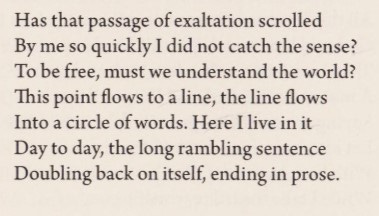
Epstein seems to describe his own works in the same manner as I try to explain. In the poem Ponte Vedra, the last stanza is
Has that passage of exaltation scrolled
By me so quickly I did not catch the sense?
To be free, must we understand the world?
This point flows to a line, the line flows
Into a circle of words. Here I live in it
Day to day, the long rambling sentence
doubling back on itself, ending in prose.
That’s right. Is he saying is his poetry is all prose? Note it says, ‘ending’ in prose, not ‘uplifted’ in prose. Somehow the light shows through these little cracks, and I believe that deep down in their little sweet hearts such poets know and see their prose as poetry as failure.
And check the subject. Almost all his poems end with a statement about his own self which is psychological evidence of said narcissism, a trait all too common among poets. The very last line in The Glass House is, “… Think of me as you will.” Always back to the author. See it?
If anyone agrees with me—they won’t say anything.
Oh, well. Why do I bother? If anyone agrees with me—they won’t say anything. Or, they will say, oh yeah, but I like these poems and I can relate. Water seeks its own level. Go on the internet and read all the accolades for poems and poetry books by Epstein. It is amazing.
One thing, I believe, will never change. The poetry world, or rather, the poetry biz and private poetry club cabals, have a death grip on a single concept, the previously mentioned “Because you probably believe that poetry is in the line and we believe that poetry is in the poem.”
This will never change. Minnows swim in schools. In other words, any bad writing will do—if there is something, even if vague or opaque, something like a half-thought or wave of the hand or swish of the cape, something in the poem which is arty or aesthetically intellectual as to be irreproachable to common sense. I have before me 5 or so recent poetry magazines and every single issue and every single poet is doing the exact same thing—the same concept! Prosy bad writing in near nonsense or something vague and icky at the end. Why don’t these writer-people see this? I have no idea. Well, that is the subject of the next essay, recent poetry magazines all following the same rules. Maybe they aren’t actually rules, but are these common patterns in modern poetry really no more than the only level at which mediocre writers can write? Maybe so.
Yes, I know I am not nice but someone needs to speak up.
Thanks for the comment! Your poetry mentor gave you great advice. Every time I read an unspecified 'you' in a poem I yell out the windows, "You Who? You Who?" [figuratively] And they still do it today, because I guess they read it in books and on line and do the same, monkey see, monkey do. And a poet once said in response to me a few years ago, "I'd rather amputate my left arm than have one of my poems mean anything." So, I think she was saying she wanted people to read her poems about nothing? The integrity in aesthetics today is appalling, but maybe it has always been that way. I'm having fun saying what I think in this substack, I hope you follow along. And if you have any ideas of whom I might review, let me know.
My first poetry mentor taught me that there are two questions poets must not forget but often do: WHO is speaking and WHAT is the poem about? He also had a vendetta against the unspecific “you”—he always said that when a poet is saying “you” and it’s not crystal clear who that is, the poet is being lazy and hasn’t figured out what he is writing about. I still use these principles when I’m evaluating my own work, and if nothing else they prevent laziness like what you’re identifying here.